
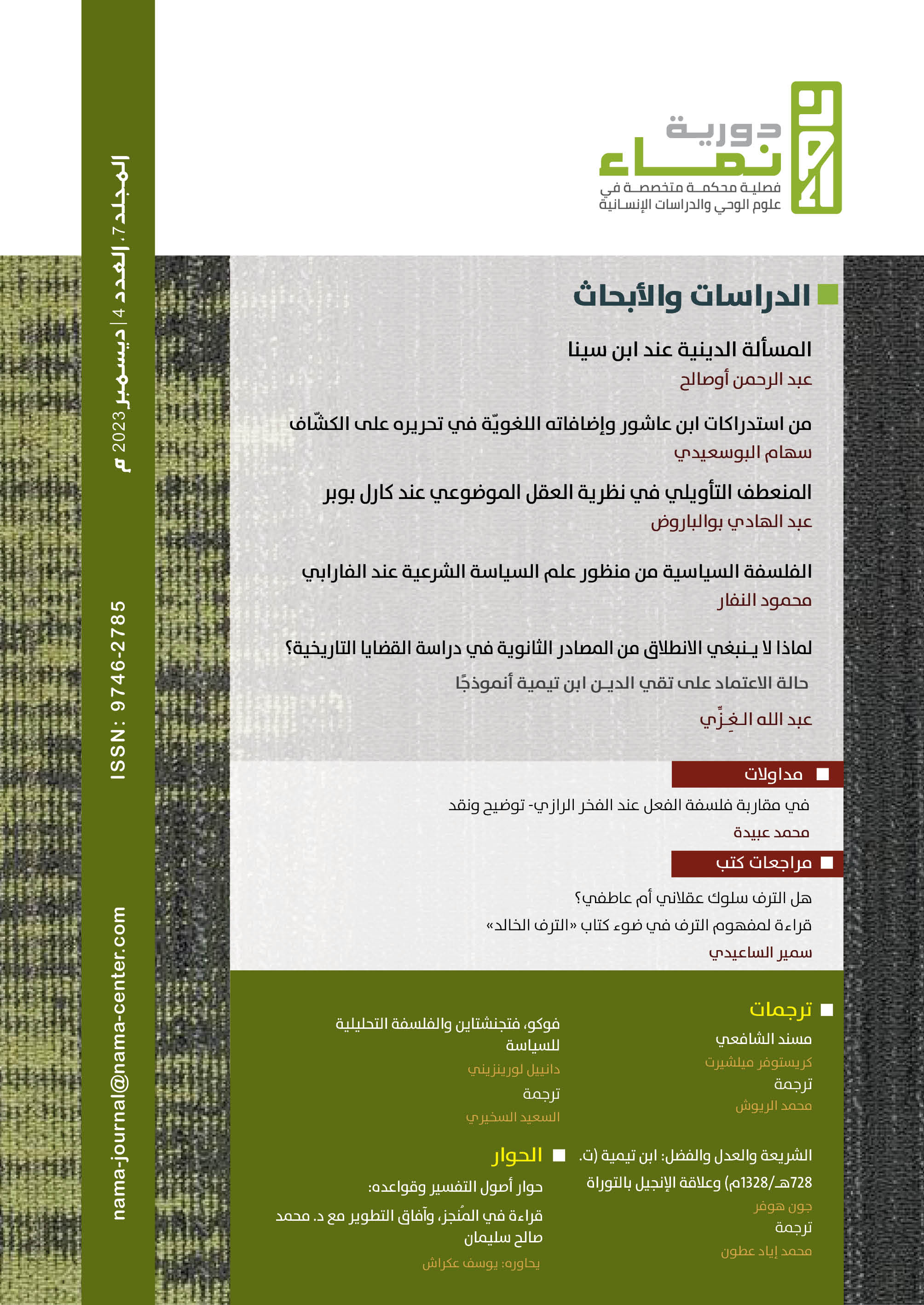
Political Philosophy from the Perspective of Islamic Politics, according to Al-Farabi

Article Sidebar
-
الفلسفة السياسية, السياسة الشرعية, تكامل المعرفة, نقد الفلسفة الإسلامية, الفارابي Political philosophy, Islamic policy, knowledge integration, criticism of Islamic philosophy, Al-Farabi
Abstract
The research evaluates political philosophy as a branch of practical philosophy, not from all its aspects, but from the perspective of legitimate (Islamic) politics and the principles upon which such politics is founded, including theological (kalam), jurisprudential, and purposive principles. The researcher employs descriptive, analytical, inductive, deductive, and comparative methods. The study consists of an introduction and nine subheadings covering the concept of legitimate politics and political philosophy. It introduces Al-Farabi and his major political works and evaluates the position of the science of legitimate politics in the classification of sciences, and elucidates the view of the jurists (fuqaha’a), most of them theologians (Mutakalimoun), on legitimate politics at the theological (kalamic), foundational (usulî), purposive (maqasidic), and jurisprudential levels. Despite the limited presence of criticism of political philosophy in projects critiquing philosophy, the research concludes that scholars of Islamic jurisprudence (sharia) have generally adopted a negative stance toward political philosophy due to its sources, principles, and approach in examining political phenomena and governance alike.
Full text article
Authors

This work is licensed under a Creative Commons Attribution-NonCommercial 4.0 International License.
yright and License
Researchers always have copyright. The research published in the Journal is licensed under the Creative Commons Attribution-Noncommercial 4.0 International License. This means that every person can download, read and use the research, provided that he/she relates it to its author appropriately, stating any amendments made. This work cannot be used for commercial purposes.